
Why TAM/SAM/SOM Models Break When the Addressable Market Shifts
By Dr. Mugdha Sawant and Dr. Laura-Marie Zimmermann, Biorizon Consulting
A TAM/SAM/SOM funnel is one of the first slides an investor scrutinises. It is also one of the first numbers a founder stops thinking about once it is approved. Total addressable market sets the ceiling. Serviceable addressable market narrows it to what the company can plausibly reach. Serviceable obtainable market turns that into the revenue forecast that anchors the valuation — and, in turn, the cap table.
The methodology is not the problem. The problem is what happens to it after the round closes. Life science products change scope constantly: an indication gets dropped after a Phase 2 readout, a label comes back narrower than modelled, or a reimbursement decision cuts the addressable population in half overnight. The funnel is supposed to be rebuilt every time this happens. In practice, it is usually left exactly as it was on the last fundraising deck, and every valuation, burn-rate plan, and follow-on ask downstream of it quietly inherits a market that no longer exists.
1. Three Numbers, Three Different Jobs
A quick refresher, since the three layers get conflated constantly: TAM, SAM, and SOM answer three different questions, not three cuts of the same number.
TAM: is this worth playing in at all? The aspiration number, the ceiling if the entire category were captured.
SAM: where is the company actually going to compete? A choice, not a calculation: which indications, geographies, and regulatory pathway it is actually pursuing.
SOM: what can actually be sold in the next 1-3 years? Execution — the number the burn rate and hiring plan should be built around.
This distinction matters because these three numbers do not move together. A company's SAM and SOM can grow without its TAM changing an inch, through a broader label, a new geography, or a partner's sales force. And a SAM can collapse while the TAM stays exactly where it was. That is precisely the failure mode this article is about.
2. Two Ways to Build the Number, and Only One Notices When the Product Changes
There are two standard approaches to sizing a market, and the difference between them is the whole story:
Top-down: start with a big, third-party number, like "the global oncology market is worth $150B," and slice it down by percentages. It is fast to build and investor-friendly, but largely blind to the company's actual product. If an indication is dropped next year, that headline figure does not shrink. It was never the company's to begin with, since it belongs to the whole category.
Bottom-up: build the number from real, countable units specific to the company, such as the number of clinics that treat this condition, times eligible patients per clinic, times price. It is slower and messier, but tied to the company's actual footprint. Drop ten of those clinics, and the number moves immediately, because it is counted from things that can actually be recounted.
High-quality market sizing triangulates both. When only the top-down number survives into the fundraising deck, that is exactly when the funnel stops noticing its own product.
3. What Happens When the Scope Shrinks and Nobody Rebuilds the Model
Here is the scenario in miniature. A company raises its seed round on a funnel built for three indications: $4.2B TAM, $1.1B SAM, $85M Year-3 SOM. Eighteen months later, one indication fails Phase 2 and gets shelved. The other two proceed. If the funnel is not rebuilt for the two-indication reality, every board deck and every follow-on pitch from that point forward keeps quoting a market that includes a product that no longer exists.
This is not a hypothetical bookkeeping slip. It is a pattern that shows up, in hard numbers, across some of the best-known restructurings in the industry. Biogen's case is the clearest. Peer-reviewed evaluation published shortly after the FDA's 2021 accelerated approval found aducanumab's underlying efficacy data too weak to support its approval, flagging the same evidentiary gaps that CMS would later cite when it restricted Medicare coverage to patients enrolled in further clinical studies, almost a year afterward [2]. The reimbursement decision that gutted Aduhelm's addressable market had a documented scientific basis, not just a market one.
| Company | What shifted | TAM/SAM/SOM impact | Capital response |
|---|---|---|---|
| Biogen (Aduhelm, 2021–2024) | Reimbursement restrictions gutted commercial uptake | TAM for Alzheimer’s stayed enormous; SOM cratered to near-zero almost overnight [3] | ~1,000 layoffs (10%+ of workforce) [3][10], Aduhelm formally discontinued 2024, capital redirected to Leqembi [4] |
| Merck (Keytruda, 2028 patent cliff) | Looming loss of exclusivity on its top-selling drug | TAM for oncology has kept growing; Merck’s own branded SOM faces a multibillion-dollar exposure once exclusivity lapses [5] | Pre-emptive SAM expansion via bolt-on deals, including a bispecific-antibody acquisition and other oncology M&A, struck years ahead of the cliff [6][7] |
| Takeda (cell therapy exit, 2023–2025) | Back-to-back late-stage failures (Exkivity withdrawal, Alofisel Phase 3 miss) | Targeted SOM for those indications wiped out overnight | $770M write-down, 71% cut to profit projections, 1,500+ layoffs in 2024 with more planned through FY2026, and a full 2025 exit from cell therapy as a modality [8][9] |
Three different triggers — a reimbursement decision, a patent calendar, a clinical failure — hit three different funnel layers, all SOM, but for entirely different reasons. Biogen and Takeda are cases of damage already realised. Merck is the same failure mode caught in advance, which is why it is spending billions of dollars, years ahead of its cliff, rather than after it arrives. What all three share is that the market did not quietly stay put. It moved, or is already known to be about to, and each company had to move its capital structure to match.
4. Why the Recalculation Gets Skipped
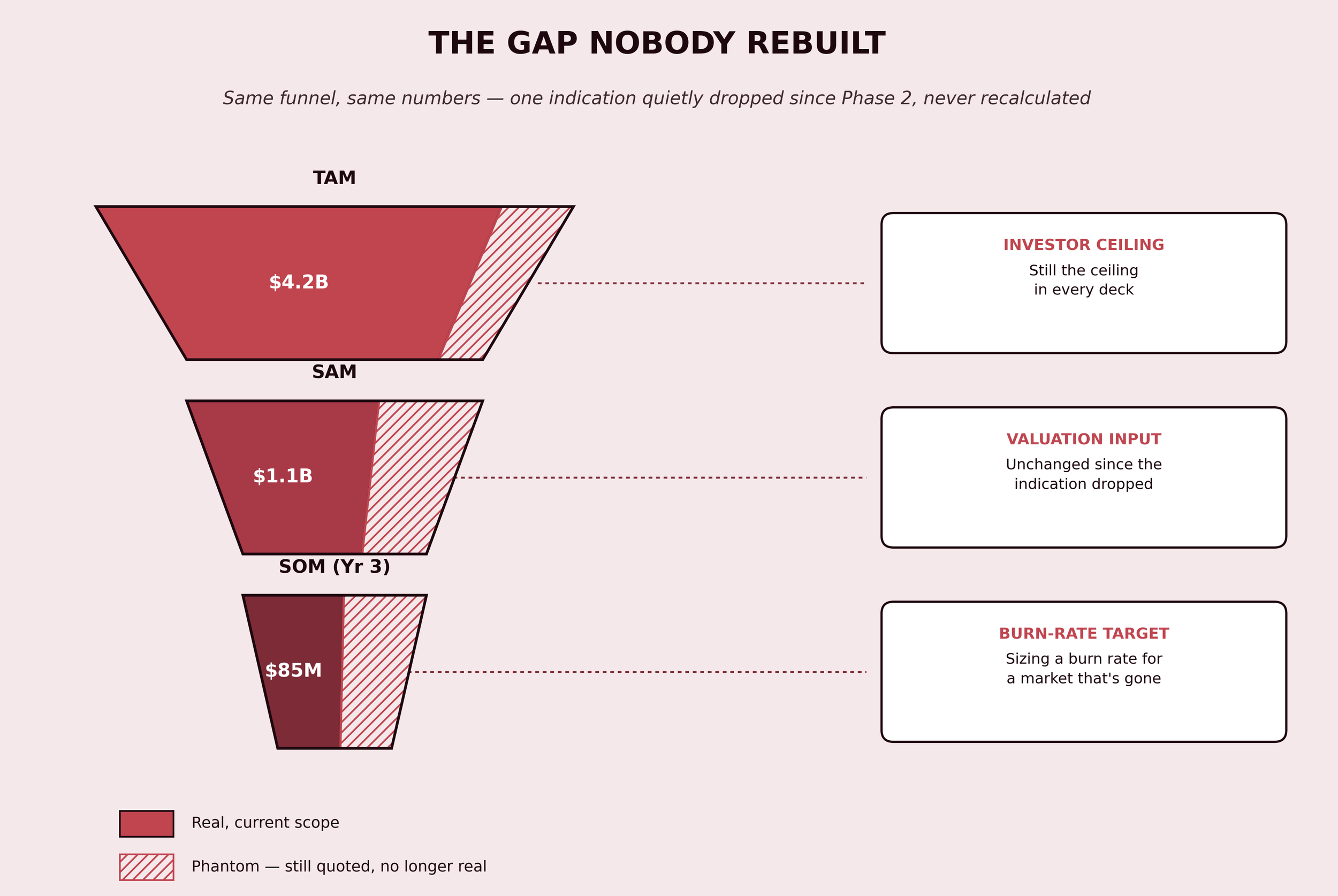
Figure 1. The gap between what is still being quoted (TAM/SAM/SOM as pitched) and what is actually true after an indication drops. That gap widens at each layer and feeds directly into the wrong investor ceiling, valuation, and burn rate.
Three structural habits keep funnels frozen past their expiry date:
Anchoring. A headline TAM becomes the number everyone repeats in every subsequent meeting. Revising it downward feels like admitting weakness, even when it is the more defensible position.
Borrowed numbers do not notice changes in scope. A top-down TAM cited from a third-party report does not move when the company's own scope does. The category-wide figure is unaffected even though the company's claim on it should be.
Recalculation is tied to fundraising, not to reality. Market sizing usually gets revisited only at the next round, not the moment a pipeline decision actually changes the scope, which leaves a gap of months, sometimes years, where the deck and the pipeline tell two different stories.
The fix is not complicated, even if it is rarely followed. Recalculation should be triggered by the event, not the calendar. The moments that should reopen the model are the same moments that already show up on every clinical and commercial timeline, and they line up with the same development-stage transitions that empirically move a company's valuation, not just its narrative. Acquirers pay materially different amounts depending on whether a lead asset sits in Phase 1, Phase 2, or Phase 3 [1] — one clear example of a moment that reprices the company itself. The same logic extends to any event that changes what the product can actually reach:
a Phase II to Phase III transition, where the risk profile — and who is willing to fund the company — changes materially [1]
a regulatory or reimbursement decision that redefines who can actually access the product
a label expansion or contraction that directly resizes SAM
a partnership event that expands or changes go-to-market reach
5. It Does Not Stay on One Slide
An un-recalculated funnel does not just misstate a market-opportunity slide. It drags every downstream financial construct along with it:
Burn rate gets sized to a revenue ramp the reduced scope can no longer support.
Valuation gets pinned to a SOM figure that overstates realistic near-term capture.
The next raise gets pitched against a ceiling the company can no longer credibly claim.
SAM and SOM are typically derived as filtered subsets of TAM, so an unrevised top-line figure does not just sit there quietly. It propagates its error through every layer beneath it. The cleanest discipline here is simple: map cash runway, cash on hand divided by burn rate, directly against the next scheduled TAM/SAM recalculation point. If a market shift devalues the niche before the runway allows for a rebuild, that is the signal to restructure costs or pursue an exit rather than wait for the next deck.
What Rigorous Market Sizing Actually Looks Like
Date-stamp the scope. Every market-sizing figure should be tied explicitly to a named set of indications, geographies, and product configurations, so a scope change is visibly a trigger, not a footnote.
Triangulate, do not just cite. Build the bottom-up number alongside the top-down citation. The bottom-up figure is the one that will actually move when the product does.
Recalculate on events, not anniversaries. Tie every rebuild to a real trigger, such as a trial readout, a label decision, or a reimbursement outcome, rather than whenever the next round happens to fall [1].
Treat the TAM as aspiration, not inventory. It tells the company whether the category is worth playing in. It should never be quoted as if it were the number the company is actually going to sell.
Conclusion
TAM/SAM/SOM models do not fail because the framework is wrong. They fail because they are treated as a one-time deliverable instead of a living calculation that has to move when the product does. Biogen, Merck, and Takeda did not get their market sizing wrong in the arithmetic sense. The ground moved under numbers that were accurate on the day they were built. The discipline that separates a durable investment thesis from a stale one is not building the funnel correctly once. It is rebuilding it every time the scope changes, with the capital structure ready to move with it.
Biorizon Consulting builds market models as part of its Elevate (investor readiness and commercial strategy for startups) and Insight (scientific due diligence for investors) advisory work. To discuss a TAM/SAM/SOM rebuild or a fundraising strategy review, reach out at info@biorizonconsulting.com.
References
[1] Michaeli, D.T., Yagmur, H.B., Achmadeev, T., & Michaeli, T. (2022). Value Drivers of Development Stage Biopharma Companies. European Journal of Health Economics, 23(8), 1287-1296. https://doi.org/10.1007/s10198-021-01427-5. Accessed: 27.07.2026.
[2] Alexander, G.C., Emerson, S., & Kesselheim, A.S. (2021). Evaluation of Aducanumab for Alzheimer Disease: Scientific Evidence and Regulatory Review Involving Efficacy, Safety, and Futility. JAMA, 325(17), 1717-1718. https://doi.org/10.1001/jama.2021.3854. Accessed: 27.07.2026.
[3] STAT News (2022). With Aduhelm in Limbo, Biogen Starts Laying Off Employees. https://www.statnews.com/2022/03/03/with-aduhelm-in-limbo-biogen-starts-laying-off-employees/. Accessed: 22.07.2026.
[4] FiercePharma (2024). Biogen Abandons Aduhelm Efforts, Focuses on Eisai-Partnered Leqembi and Pipeline Meds. https://www.fiercepharma.com/pharma/biogen-abandons-aduhelm-efforts-focuses-eisai-partnered-leqembi-and-pipeline-meds. Accessed: 22.07.2026.
[5] Merck & Co., Inc. (2025). Form 10-K, Fiscal Year 2024, Risk Factors and Patents section (Keytruda U.S. exclusivity expiration, December 2028). U.S. Securities and Exchange Commission. https://www.sec.gov/Archives/edgar/data/310158/000162828025007732/mrk-20241231.htm. Accessed: 27.07.2026.
[6] FiercePharma (2026). Girding Against Keytruda Cliff, Merck Splits Oncology Into Standalone Business Unit. https://www.fiercepharma.com/pharma/girding-against-keytruda-cliff-merck-splits-oncology-standalone-business-unit. Accessed: 22.07.2026.
[7] BioPharma Dive (2024). Merck, Facing Threat to Keytruda, Buys Into New Kind of Cancer Immunotherapy. https://www.biopharmadive.com/news/merck-lanova-pd1-vegf-bispecific-cancer-drug-deal/732906/. Accessed: 22.07.2026.
[8] BioSpace (2026). Big Pharma Restructures to Ride Out 'Existential Risk'. https://www.biospace.com/business/big-pharma-restructures-to-ride-out-existential-risk. Accessed: 22.07.2026.
[9] FierceBiotech (2025). Takeda Lays Off 137 US Staff as Part of Retreat From Cell Therapy. https://www.fiercebiotech.com/biotech/takeda-taps-out-cell-therapy-arena-part-strategic-shift. Accessed: 22.07.2026.
[10] Chemistry World (2024). Biogen to Cut 1000 More Jobs by 2025. https://www.chemistryworld.com/news/biogen-to-cut-1000-more-jobs-by-2025/4017825.article. Accessed: 22.07.2026.
This article is provided for informational purposes only and does not constitute investment advice or an offer to buy or sell any security.